
 +86-18958951029
 sales@wohuaplastic.com
PC/ABS vs PC/PBT: Choosing the Right Engineering Plastic Alloy for Your Application
What are Engineering Plastic Alloys?
Engineering plastic alloys combine two or more polymers to create a material with properties superior
to either component alone. Among the most popular alloys are PC/ABS (Polycarbonate/Acrylonitrile
Butadiene Styrene) and PC/PBT (Polycarbonate/Polybutylene Terephthalate).
At Wenzhou Wohua Plastic, we supply both PC/ABS and PC/PBT alloys from KINGFA. Understanding
the differences helps you select the optimal material for your specific application.
PC/ABS: The Balanced Performer
PC/ABS alloys combine the impact strength and heat resistance of polycarbonate with the processability
and surface finish of ABS.
Key properties:
- Impact strength (notched Izod): 400-700 J/m (depending on PC/ABS ratio)
- HDT: 100-125℃ (1.82 MPa)
- Excellent surface finish suitable for painting and texturing
- Good dimensional stability
- FR grades available to UL94 V-0 (0.8-1.6mm)
- Processing temperature: 240-280℃
Typical PC/ABS ratios:
- 70/30 (PC/ABS): Higher impact, better heat resistance
- 60/40: Balanced properties, most common
- 50/50: Better flow, improved surface finish
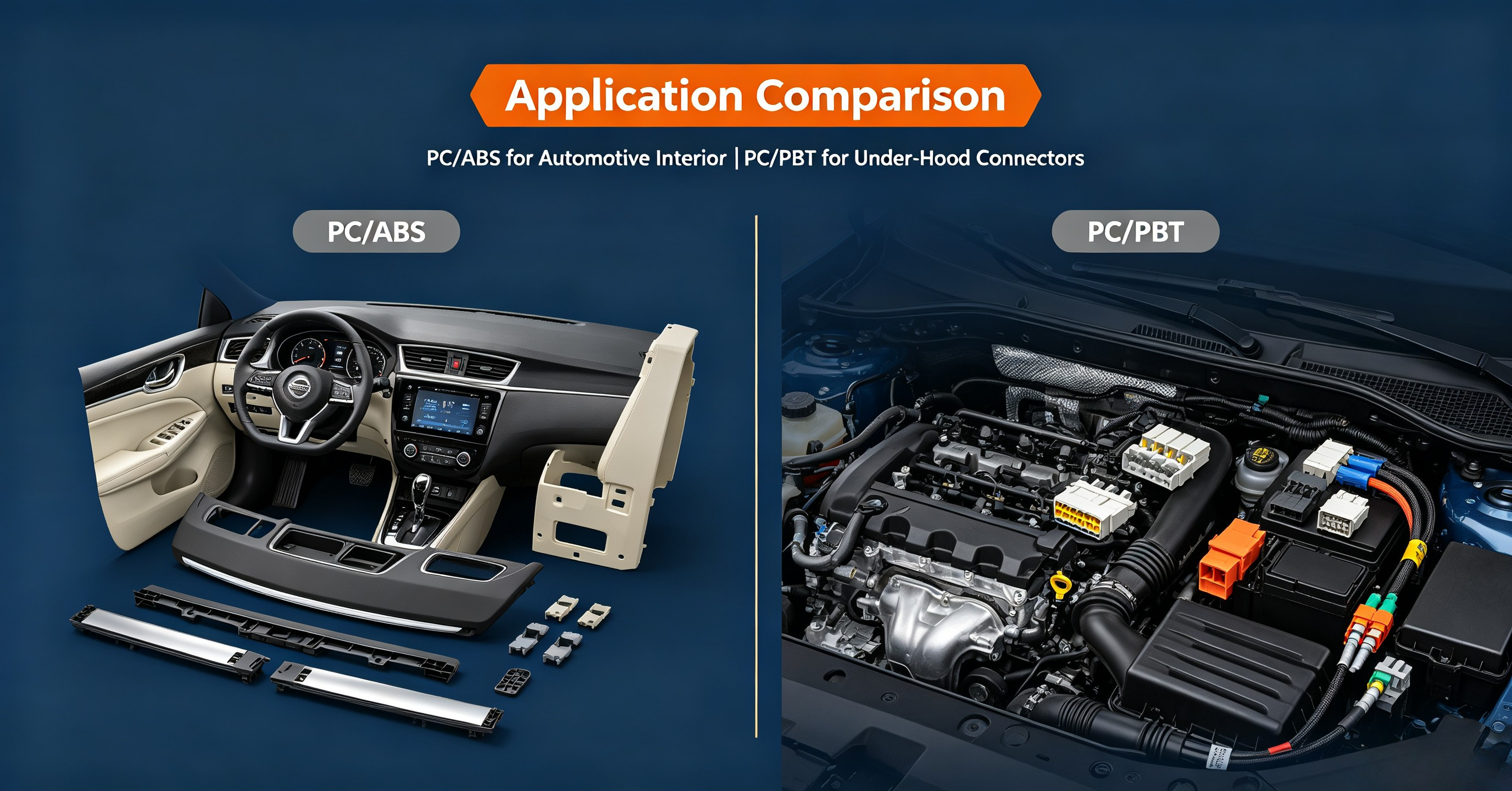
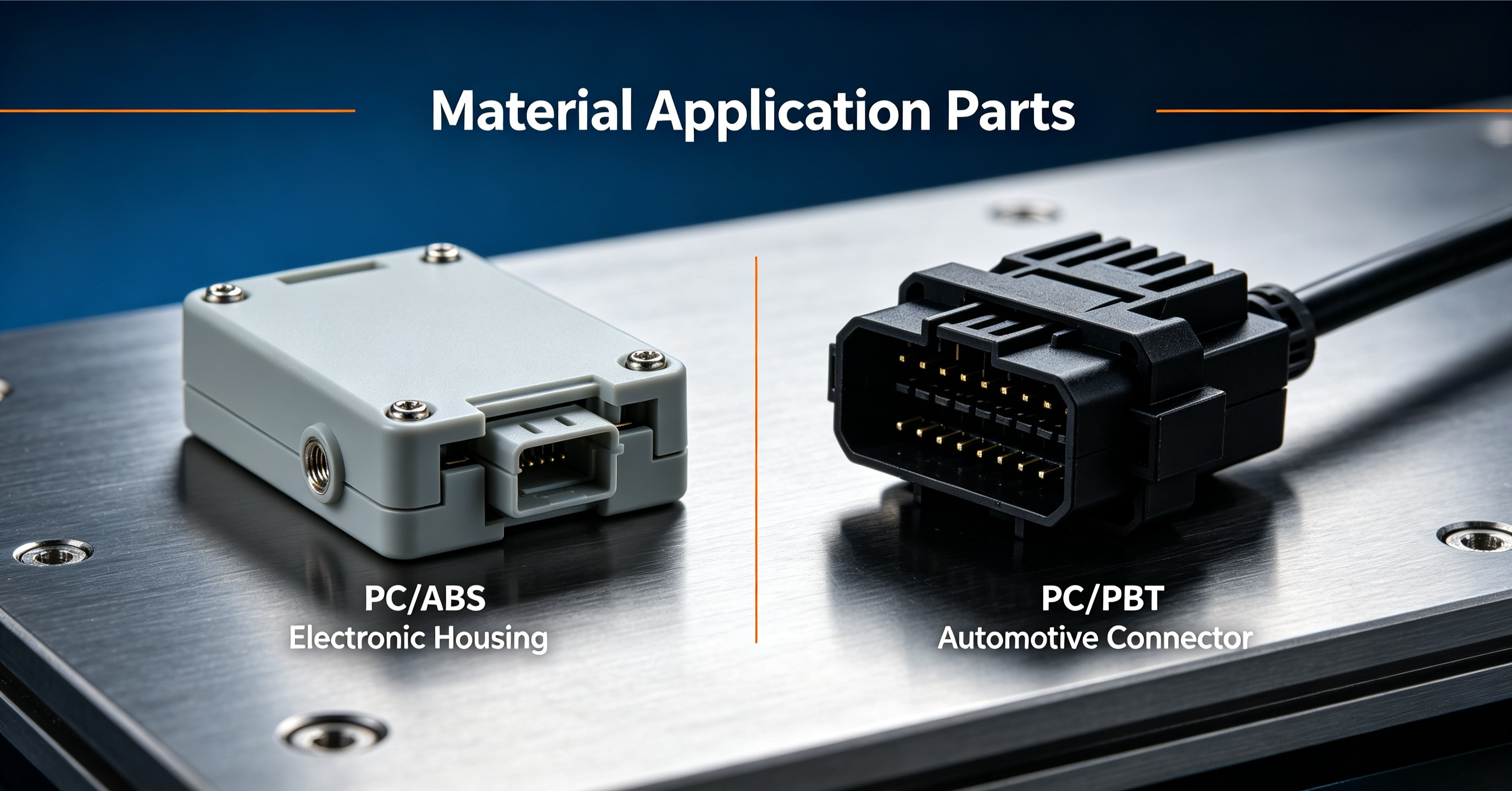
Ideal applications: Automotive instrument panels, interior trim, electronic device housings, power tool bodies,
EV charging station enclosures.
PC/PBT: The Chemical and Heat Resistant Alternative
PC/PBT alloys combine polycarbonate's toughness with PBT's excellent chemical resistance, dimensional
stability, and electrical properties.
Key properties:
- Impact strength (notched Izod): 500-800 J/m
- HDT: 110-140℃ (1.82 MPa)
- Excellent chemical resistance to oils, greases, and fuels
- Superior dimensional stability in humid environments
- Very low moisture absorption (0.08% vs PC/ABS 0.2-0.3%)
- Good electrical insulation properties
- Processing temperature: 250-290℃
Ideal applications: Automotive under-hood connectors, fuel system components, industrial sensor housings,
outdoor electrical enclosures, power tool components exposed to oils.
7-Dimension Comparison: PC/ABS vs PC/PBT
| Dimension | PC/ABS | PC/PBT | Winner |
|---|---|---|---|
| Impact Strength | 400-700 J/m | 500-800 J/m | PC/PBT |
| Heat Resistance (HDT) | 100-125℃ | 110-140℃ | PC/PBT |
| Chemical Resistance | Good (mild) | Excellent | PC/PBT |
| Dimensional Stability (humidity) | Good | Excellent | PC/PBT |
| Surface Finish | Excellent | Good | PC/ABS |
| Processability | Excellent | Good | PC/ABS |
| Cost | Lower | Higher | PC/ABS |
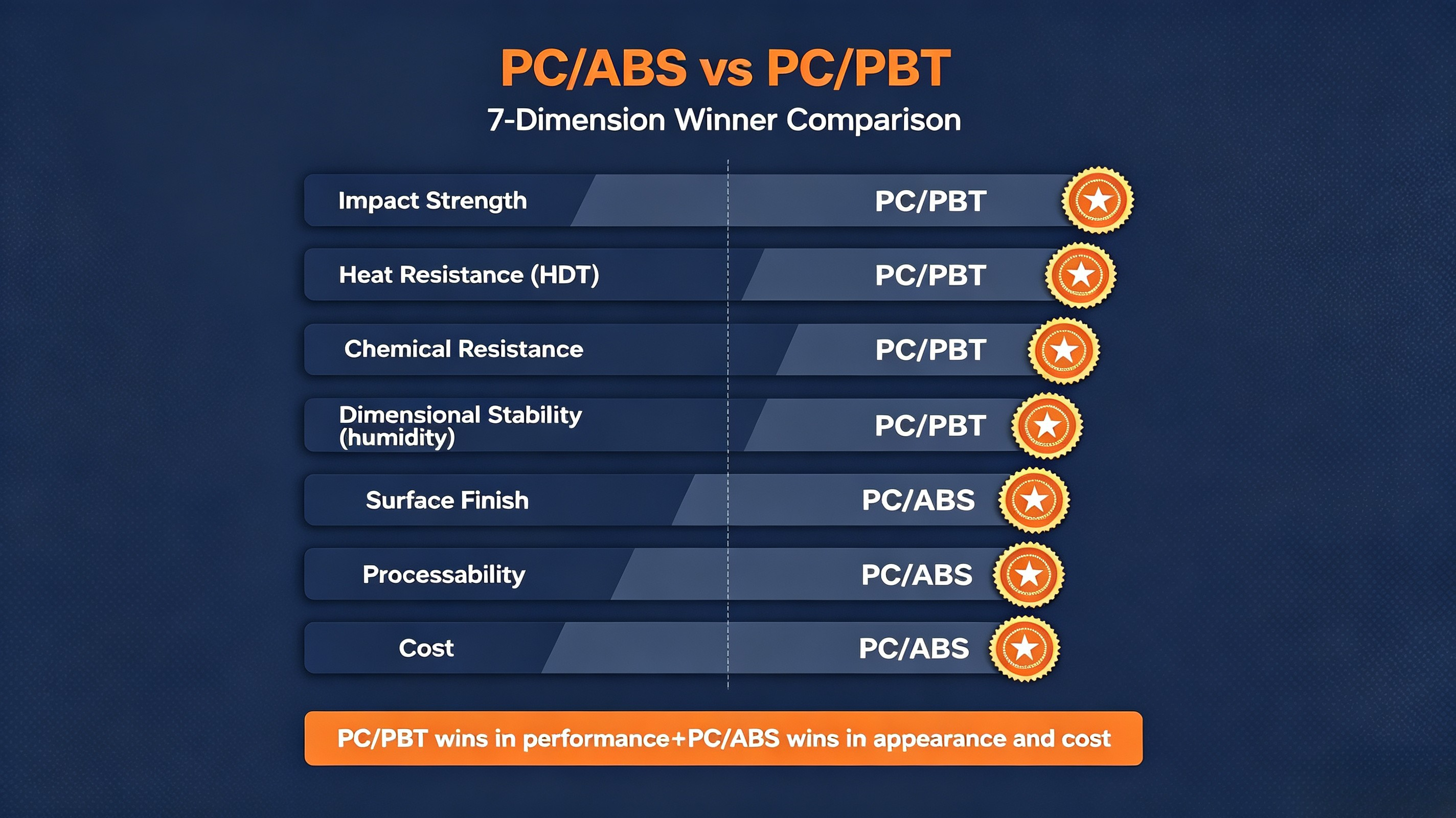
Bottom line: PC/ABS is generally the better choice for aesthetic parts requiring excellent surface finish and easy
processing. PC/PBT is preferred for technically demanding applications requiring chemical resistance, heat
resistance, and dimensional stability in challenging environments.
When to Choose PC/ABS
Choose PC/ABS when:
- Surface appearance is critical (visible interior parts, consumer electronics)
- Painting, coating, or texturing is required
- Easy processing with complex tooling
- Cost is a primary consideration
- UV stability is needed (UV-stabilized grades available)
- Flame retardancy is required (FR V-0 grades widely available)
Budget indicator: PC/ABS is typically 15-25% more economical than comparable PC/PBT grades.
When to Choose PC/PBT
Choose PC/PBT when:
- Continuous exposure to oils, greases, or fuels
- High humidity or wet environments
- Dimensional stability across varying moisture levels
- Higher heat deflection temperature required (above 125℃)
- Excellent electrical insulation in humid conditions
- Under-hood automotive applications
Note: PC/PBT requires higher processing temperatures and may need more careful mold design. However,
the performance benefits often justify the additional cost.
Wohua Plastic's Alloy Solutions
Wenzhou Wohua Plastic supplies both PC/ABS and PC/PBT alloys from KINGFA:
PC/ABS Grades:
- Standard grade: General purpose, good balance
- FR V-0 grade: UL94 V-0 at 0.8-1.6mm
- UV-stabilized grade: Outdoor applications
- GF-reinforced grade: Additional stiffness
PC/PBT Grades:
- Standard grade: Excellent chemical resistance
- FR V-0 grade: For electrical applications
- GF-reinforced grade: Higher stiffness
- Impact modified grade: Extreme toughness
Contact us for datasheets, samples, and technical consultation.
📩 sales@wohuaplastic.com
🌐 www.wohuaplastic.com