
 +86-18958951029
 sales@wohuaplastic.com
Modified vs General Plastics: 5 Key Differences
Industry Background
When selecting plastic materials, many customers ask: "What's the real difference between modified
and general plastics? Is the extra cost worth it?"
The answer depends entirely on your application. This article compares the two across five dimensions
to help you make smarter material decisions.
1. Performance: From Adequate to Tailored
General plastics (PP, PE, ABS) meet basic needs but hit performance ceilings in strength, heat resistance,
and flame retardancy.
Modified plastics add reinforcements, flame retardants, impact modifiers, and other additives to achieve
targeted performance improvements:
• Tensile strength: General PP ~30 MPa → GF-reinforced PP ≥ 100 MPa
• HDT: General ABS ~90°C → Modified ABS up to 120°C+
• Flame retardancy: Standard plastics are flammable → Modified can reach UL94 V-0
2. Cost: Total Cost vs Unit Price
Modified plastics have a higher per-kg price but consider the total cost:
• Less material: Higher strength allows thinner walls, reducing part weight
• Lower rejection rate: Optimized flow improves molding yield
• Eliminates secondary operations: FR modification removes the need for post-mold coating
Case study: A client switched from general ABS to FR-modified ABS. Material cost increased by 15%,
but overall cost dropped by 8% due to higher yield and eliminated post-processing.
3. Applications: From Limited to Limitless
General plastics have fixed application ranges, while modified plastics can be formulated for specific needs:
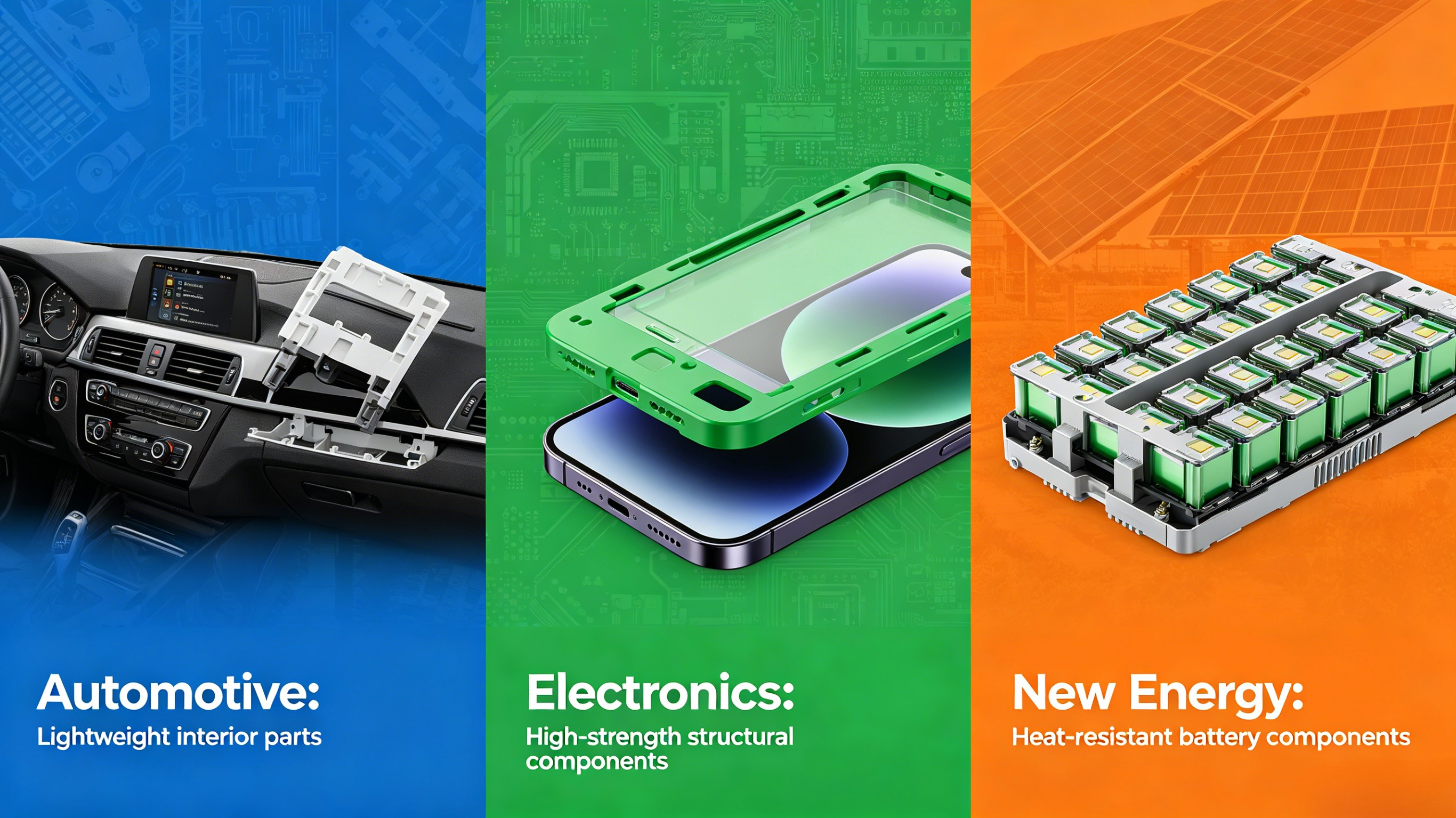
• Automotive: Modified PP/PA6/PA66 for engine components, interior and exterior parts
• Electronics: FR PC/ABS, FR PBT for housings and connectors
• New energy: UV-stabilized materials for charging stations and solar components
• Medical: Antimicrobial modified materials for device housings
Modified plastics make "replacing metal with plastic" a reality.
4. Processing: Designed for Production
Modified plastics are developed with processing in mind:
• Optimized flow for complex mold filling
• Controlled shrinkage for dimensional stability
• Wide processing window for temperature and pressure tolerance
This means shorter setup time and better production consistency.
5. Supply Chain: OEM vs Third-Party
General plastics are widely available but can have batch-to-batch variation.
Reputable modified plastic suppliers (like KINGFA and HIGHSUN) maintain strict formulation management
and quality control:
• Consistent batch quality guaranteed
• Test reports provided with each batch
• Responsive technical support
Choosing a reliable supplier may cost a bit more per kg but eliminates hidden costs from quality inconsistency.
Selection Recommendations
When to choose general plastics:
• Mild environment with no special requirements
• Extreme cost sensitivity
• High volume with standard quality needs
When to choose modified plastics:
• Specific performance targets (heat, FR, strength, etc.)
• Weight reduction and thin-wall design
• Safety certification requirements (UL, CE, etc.)
• Product quality differentiation