
 +86-18958951029
 sales@wohuaplastic.com
Engineering Plastics: Classification, Properties, and Key Applications
At Wohua Plastic, we specialize in providing high-performance material solutions for demanding industrial environments. Understanding the distinct classifications of engineering plastics is essential for optimizing product design, manufacturing efficiency, and long-term reliability.
This article breaks down the major categories of engineering plastics and their typical applications to help you select the right material for your next project.
1. What Are Engineering Plastics?
Engineering plastics are a group of plastic materials that exhibit superior mechanical and thermal properties compared to commodity plastics (such as PE, PP, or PVC). They maintain structural integrity and dimensional stability under mechanical stress, high temperatures, and chemical exposure, making them ideal for precision components in automotive, electronics, industrial machinery, and medical devices.
2. Classification of Engineering Plastics
Engineering plastics are typically divided into three tiers: standard engineering plastics, high-performance plastics, and modified/blended materials.
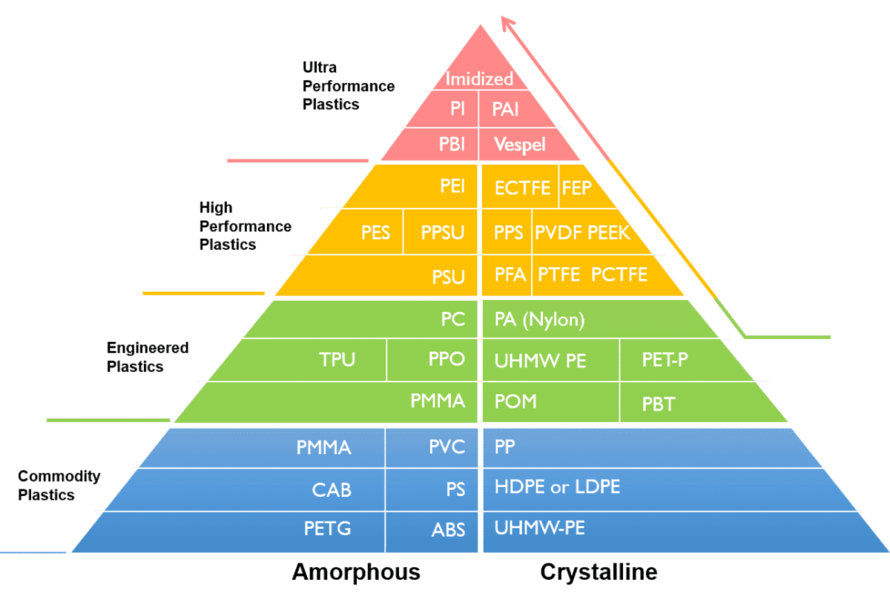
2.1 Standard Engineering Plastics
These materials offer a balanced combination of mechanical strength, heat resistance, and cost-effectiveness.
| Material | Key Properties | Common Applications |
| PA (Polyamide / Nylon) | High toughness, wear resistance, low friction | Gears, bearings, automotive engine covers |
| PC (Polycarbonate) | High impact strength, optical clarity, dimensional stability | Electrical housings, automotive headlamps, safety shields |
| POM (Polyoxymethylene / Acetal) | High stiffness, excellent dimensional stability, low moisture absorption | Precision gears, valves, conveyor belts, zippers |
| PBT (Polybutylene Terephthalate) | Good electrical insulation, chemical resistance, fast molding | Connectors, relays, automotive sensor housings |
2.2 High-Performance Plastics
These materials are used in extreme environments where standard engineering plastics may fail.
| Material | Key Properties | Common Applications |
| PEEK (Polyether Ether Ketone) | Exceptional thermal stability (up to 260°C), chemical resistance, high strength | Aerospace components, medical implants, oil & gas seals |
| PSU (Polysulfone) | High hydrolytic stability, transparent, steam sterilizable | Medical instruments, food processing equipment |
| PI (Polyimide) | Outstanding high-temperature resistance (up to 400°C), low outgassing | Semiconductor equipment, aerospace structural parts |
3. Key Application Areas
Automotive & E-Mobility
The shift toward lightweighting in electric vehicles (EVs) has accelerated the use of engineering plastics. PA66 and PBT are widely used in battery components, cooling lines, and connector systems due to their flame retardancy and thermal stability.
Electronics & Electrical
High precision and insulation are non-negotiable. POM and PC are utilized for intricate components like switches, circuit breakers, and mobile phone structural parts, ensuring reliability in compact spaces.
Industrial Machinery
For moving parts subjected to continuous friction, POM and PA are preferred for gears, bushings, and wear strips. Their self-lubricating properties reduce maintenance costs and extend service life.
Medical & Healthcare
Sterilization resistance is critical. PEEK and PSU are commonly found in surgical instruments, dental tools, and reusable medical devices due to their ability to withstand repeated autoclaving without degradation.
4. Choosing the Right Material
Selecting the correct engineering plastic requires evaluating four key parameters:
Thermal Requirements: Continuous operating temperature and peak exposure.
Mechanical Load: Tensile strength, creep resistance, and impact requirements.
Chemical Exposure: Contact with oils, solvents, or cleaning agents.
Regulatory Compliance: UL94 flame rating, FDA food contact, or ISO 10993 biocompatibility.
At Wohua Plastic, our technical team provides tailored support to match material properties with your specific application needs.
Conclusion
Engineering plastics are the backbone of modern manufacturing, offering durability, precision, and efficiency. By understanding the distinct classifications—from standard resins like PA and POM to high-performance materials like PEEK—manufacturers can achieve superior product performance and cost optimization.
Looking for reliable engineering plastic solutions?
Contact Wohua Plastic to discuss your material specifications or request a sample.